








Quick Facts
- State: Uttar Pradesh (Braj region, Mathura district)
- Duration: 4 days / 3 nights
- Budget: Rs 6,000-9,600 (budget) | Rs 15,500-22,400 (mid-range) | Rs 29,000-51,000 (premium)
- Best Season: Late February to mid-March (Braj celebrations start 7-10 days before Holi)
- Nearest Airport: Delhi IGI (150 km) | Agra Airport (58 km, limited flights)
- Railway Station: Mathura Junction (your base for everything)
- Best For: Solo travelers, friends groups, photographers, cultural adventurers
I spent three evenings cross-referencing temple schedules, train timetables, auto-rickshaw pricing, and TripAdvisor threads from people who’d actually done this trip. The Braj Holi circuit is one of those things where the information online is either inspirational fluff (“experience the colours of Krishna’s homeland!”) or so outdated that the train numbers don’t exist anymore.
- Who This Itinerary Is For (And Who Should Skip It)
- The Route
- Day 1 — Barsana and Nandgaon: Lathmar Holi (~March 7, 2026)
- Morning: Delhi to Barsana
- 10:00 AM — Barsana: Lathmar Holi
- 2:30 PM — Nandgaon (10 km, 20-minute drive)
- 5:00 PM — Drive to Mathura (45 km, 1.5 hours)
- Evening: Mathura
- Day 2 — Vrindavan: Temple Holi (~March 8-10, 2026)
- Morning: Vrindavan Temples (Before the Colour Starts)
- Afternoon: Banke Bihari Temple — The Main Event
- Late Afternoon: ISKCON Vrindavan (4:30 PM)
- Evening: Vrindavan Parikrama Walk
- Day 3 — Mathura: Holika Dahan and Street Holi (March 13-14, 2026)
- Morning: Mathura Heritage Walk
- Evening: Holika Dahan (March 13, 2026)
- Day 3/Day 4 Crossover — Rangwali Holi (March 14)
- Day 4 — Govardhan Circuit and Return (~March 15, 2026)
- Morning: Govardhan Parikrama and Kusum Sarovar
- Afternoon: Krishna Janmabhoomi and Departure
- Departure: Mathura to Delhi
- Where to Stay
- Food — Where to Eat Each Meal
- Total Budget Breakdown (Per Person, 4 Days / 3 Nights)
- What to Pack
- Alternatives and Extensions
- Frequently Asked Questions
This is the clean version. Four days. Three towns. Every meal, every temple timing, every auto fare.
Who This Itinerary Is For (And Who Should Skip It)
This is for anyone who wants to see Holi as it actually exists in the place it comes from. Not a party. Not a colour run. A sequence of temple rituals, village traditions, and street celebrations spread across the Braj region where Krishna grew up.
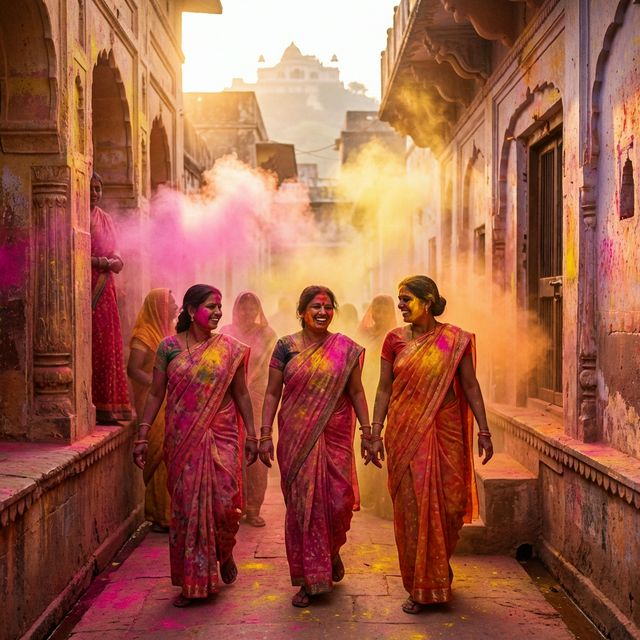
You’ll move through three towns in four days. Each has its own version of Holi, and they’re so different they barely share a name. Barsana’s is physical — women hitting men with sticks in a 400-year-old ritual. Vrindavan’s is devotional — temple doors opening and closing while priests drench crowds in saffron water. Mathura’s is communal — open-air colour play along the Yamuna ghats.
This works for solo travelers (Braj is safe, walkable, and every second person is a pilgrim), friends groups of 2-4 (the ideal size for navigating temple crowds), and photographers (every day offers a completely different visual palette).
It’s not designed for families with young children. Day 1 and parts of Day 2 involve dense, physical crowds where you cannot control what happens around you. Be honest about your comfort level.
The Route
Delhi –> Barsana (170 km, 4 hrs)
Barsana –> Nandgaon (10 km, 20 min)
Nandgaon –> Vrindavan (45 km, 1.5 hrs)
Vrindavan –> Mathura (12 km, 30 min)
Mathura –> Delhi (160 km, 2.5 hrs by train)
Your base for all four days: Mathura. Everything is within 50 km of Mathura Junction. This matters because accommodation in Vrindavan during Holi week is either booked solid or priced insanely. Mathura gives you options.
Day 1 — Barsana and Nandgaon: Lathmar Holi (~March 7, 2026)
Lathmar Holi falls roughly 9 days before Rangwali Holi. Confirm the exact date 2 weeks before travel — I’ve seen it shift by a day in some years.
Morning: Delhi to Barsana
- Depart Delhi: 5:30-6:00 AM. Yes, that early. The drive takes 3.5-4 hours on a normal day, but Holi week traffic on NH-19 adds 30-60 minutes.
- Transport: Hire a cab for the full day — Rs 2,500-3,500 (Ola Outstation or a local operator). This is the only practical option since Barsana and Nandgaon have no direct train service.
- Arrive Barsana: 9:30-10:00 AM
10:00 AM — Barsana: Lathmar Holi
Climb to the Radha Rani Temple hilltop first. Not for the temple — for the view. From above, you can see the narrow lane where the main event happens, and it gives you a sense of scale before you wade into it.
Then come down into the lanes below.
Men from Nandgaon (Krishna’s village) arrive singing provocative songs. Women from Barsana — representing Radha’s side — wait with lathis, which are long wooden sticks. When the two groups meet in the lanes below the temple, the women strike and the men defend with circular shields. This is not performance art. Sticks crack against shields. Colour flies simultaneously. The crowd presses forward.
Action starts around 11:00 AM, peaks at noon, winds down by 1:30-2:00 PM.
- Keep valuables in a waterproof pouch worn under your kurta. No backpack — it will get grabbed or pulled.
- Position yourself at the edges of the lane for an exit route. Centre of the crowd is intense.
- Phone in a ziplock bag. The colour water reaches everywhere.
- Women travelers: you’ll be among thousands of local women participants. Safe, but stay in groups.
2:30 PM — Nandgaon (10 km, 20-minute drive)
Arrive to see the aftermath of the day’s secondary celebration. Nandgaon has a different feel — smaller, less touristed, more village. Walk through lanes smeared in colour, visit Nand Bhavan Temple (tradition says Krishna was raised here).
The next day, roles reverse: men from Barsana travel to Nandgaon and face Nandgaon’s women. If your dates allow, return for the reverse Lathmar. It’s worth the second trip — the energy is different when the home team is defending.
5:00 PM — Drive to Mathura (45 km, 1.5 hours)
Check in. Shower. Collapse for 30 minutes. You’ll need it.
Evening: Mathura
Walk to Vishram Ghat for the evening aarti at 7:00 PM. The Yamuna riverfront is lit with diyas. This aarti isn’t as famous as Varanasi’s — and honestly, that’s part of its appeal. It’s smaller, calmer, and you can stand right at the water’s edge. Temple bells, incense, and the first quiet moment of your day.
Dinner: Brijwasi Mithai Wala (near Holi Gate, Mathura). Thali Rs 150-200. Their peda is legendary — Rs 350/kg, buy some for the train back. The kachori-sabzi combo is Rs 50 and better than it has any right to be.
Day 2 — Vrindavan: Temple Holi (~March 8-10, 2026)
Multiple temples celebrate on different days. Phoolon Ki Holi (flower Holi) is around March 4-5. Gulal Holi runs March 6-12 at different temples daily. Check locally for which temple is celebrating on your Day 2 — the schedule is fluid.
Morning: Vrindavan Temples (Before the Colour Starts)
Depart Mathura at 7:00 AM by auto (Rs 200-300, 30-40 minutes).
First stop: Prem Mandir (opens 5:30 AM, best at 7:00 AM when it’s empty). White marble Krishna-Radha temple built in 2012. No Holi chaos here — this is architecture. The carved panels depicting Krishna’s life story take 30-40 minutes to walk through properly. Entry free.
Second stop: Radha Vallabh Temple (8:30 AM). One of the original seven temples of Vrindavan. Simpler, older, less crowded. If it’s their colour day, expect organized kirtan and gentle gulal. If not, it’s a calm visit — and calm is valuable on this trip.
Afternoon: Banke Bihari Temple — The Main Event
Arrive by 1:30 PM. The colour ceremony runs roughly 2:00-4:00 PM, though the timing shifts — ask any local shopkeeper for the day’s schedule.
What happens is unlike anything you’ll experience at a festival anywhere.
The temple doors open for approximately 30 seconds. Priests throw coloured water and gulal at the crowd packed into the courtyard. The doors slam shut. Everyone catches their breath. They open again. Another wave of colour. By the third opening, the deity is invisible behind a haze of saffron and pink. The energy is controlled devotional chaos — intense, packed, loud with chanting.
By the fifth opening, you stop flinching. By the seventh, you’re chanting too.
- Leave your phone with the shoe-keeper at the entrance (tip Rs 20). You will not keep it dry inside. Alternatively: waterproof pouch (Rs 100 on Amazon, or Rs 10 ziplock from any Mathura shop).
- Wear clothes you’re ready to throw away. White cotton kurta, Rs 200-300 from any Mathura market shop.
- Apply coconut oil on face, arms, and neck before entering. Colour binds to oil and washes off 80% easier. This single tip saves you two hours of post-Holi scrubbing.
- The temple gets extremely crowded. If you’re solo, stick to the edges and let the crowd flow carry you. Don’t fight the current.
Late Afternoon: ISKCON Vrindavan (4:30 PM)
After Banke Bihari, walk 15 minutes to ISKCON Vrindavan (Sri Sri Krishna Balaram Mandir). This is the structured, organized version — kirtan sessions, floral decorations, gentler colour play in the courtyard. Good for decompressing after Banke Bihari’s intensity.
And honestly? If Banke Bihari sounds too much for you, skip it entirely and spend more time here instead. No shame in that. ISKCON gives you the Holi experience without the crowd anxiety.
Dinner: ISKCON restaurant (inside the complex). South Indian + North Indian, clean, reliable. Rs 120-180/plate. The masala dosa is surprisingly good for Uttar Pradesh.
Evening: Vrindavan Parikrama Walk
If energy permits — and it’s a genuine “if” at this point — walk the Vrindavan Parikrama path. The circumambulation route around the town’s sacred boundary. At dusk, the lane is quiet, lit by temple lights, and washed in the colour residue of the day. 5 km loop. Takes 60-90 minutes at a slow pace.
Return to Mathura by auto, Rs 200-300, 30 minutes. You’ll be in bed by 9.
Day 3 — Mathura: Holika Dahan and Street Holi (March 13-14, 2026)
If your Day 3 falls before Holika Dahan, swap Days 3 and 4 to align with the dates. The itinerary is modular — rearrange around the fixed Holika Dahan date.
Morning: Mathura Heritage Walk
Mathura isn’t just a base. It’s a 5,000-year-old city. Before the colour chaos starts, there’s proper heritage to see.
8:00 AM: Dwarkadhish Temple — Mathura’s largest Krishna temple. Built in 1814 by Seth Gokuldas Parikh. Ornate sandstone carvings, swing festival courtyard. The temple celebrates its own Holi on a swing (jhula) — check if this coincides with your visit. Entry free. Shoes off.
9:30 AM: Walk to Vishram Ghat — 25 steps down to the Yamuna. Krishna is said to have rested here after killing Kansa. Morning light on the river, boats, and temple spires is strong photography. If you have a camera, this is your hour.
10:30 AM: Mathura Museum (Government Museum, Dampier Nagar). One of India’s most important archaeological collections and massively under-visited. Kushan-period Mathura school sculptures. Standing Buddha from the 2nd century CE. Entry Rs 20. Open 10:30 AM-4:30 PM. Closed Mondays. Skip it if you’re not into sculpture. But if you are — this is world-class material in a dusty building with zero crowd.
Evening: Holika Dahan (March 13, 2026)
Bonfires are lit across Mathura after sunset, around 6:30 PM. The largest ones are near Holi Gate and Vishram Ghat. This is communal — families, pilgrims, travelers gathering around neighbourhood fires.
Priests perform puja. Families circle the bonfire. Children carry small handheld bonfires through the lanes. The smell is woodsmoke and marigold, and it’s one of those sensory things that stays with you longer than any photograph.
Dinner: Street food around Holi Gate. Aloo tikki Rs 20-30, jalebi Rs 40/plate, lassi Rs 30-50. Cash only.
Day 3/Day 4 Crossover — Rangwali Holi (March 14)
Colour play begins at sunrise. The streets around Holi Gate and Vishram Ghat are the primary zones. This is open-air, unstructured celebration — colours, water, dholak drums. Everyone participates.
By 1:00-2:00 PM, the intensity drops. Most people head indoors.
Strategy that works: Go out at first light, 6:00-7:00 AM, when the colours are fresh and the crowds are manageable. Return to your hotel by noon. The early hours are more photogenic, more joyful, and less aggressive than late morning when things can get rowdy.
Day 4 — Govardhan Circuit and Return (~March 15, 2026)
Morning: Govardhan Parikrama and Kusum Sarovar
Depart Mathura at 7:00 AM. Govardhan is 25 km west, a 40-minute drive. Auto Rs 400-500.
Govardhan Hill — the hill Krishna is said to have lifted on one finger to protect Braj from Indra’s rains. Pilgrims walk the 21 km Govardhan Parikrama barefoot. You don’t need to do the full loop. Walk the first 3-4 km from the starting point at Daan Ghati Temple to get a sense of the ritual and the landscape.
Kusum Sarovar (2 km from Govardhan town centre) — and this is the stop I’d be most upset about missing. A sandstone pool surrounded by 16th-century cenotaphs and carved canopies. Built during the Mughal period. Surprisingly well-preserved. Architecturally striking. And almost always empty.
One of Braj’s most underrated spots. Entry free. 30 minutes is enough, but you’ll want longer.
Return to Mathura by 11:00 AM.
Afternoon: Krishna Janmabhoomi and Departure
11:30 AM: Krishna Janmabhoomi — the site where Krishna is believed to have been born. The complex includes Keshav Dev Temple and the prison cell (garbh griha) where Devaki gave birth. Strict security — no phones, no bags, no cameras inside the inner sanctum. Leave everything at the locker facility outside (free). Entry free.
1:00 PM: Lunch at Shree Amba Restaurant (near Mathura Junction). Punjabi-style thali Rs 180-250. Solid full meal before your train.
Departure: Mathura to Delhi
| Option | Details | Cost |
|---|---|---|
| Direct train | Taj Express (Dep 16:55, Arr Delhi 19:55, 3 hrs) | Rs 150-300 |
| Via Agra | Mathura to Agra Cantt (1 hr), then Vande Bharat to Delhi (1.5 hrs) | Rs 900-1,600 |
| Cab | Ola/Uber Outstation, 3-3.5 hours | Rs 2,500-3,500 |
Where to Stay
Stay in Mathura, not Vrindavan. I’ll say it again because every other guide recommends Vrindavan. Mathura has more hotel options, lower Holi-week price inflation, and Vrindavan is 30 minutes away by auto. The math works out better here.
| Tier | Hotel | Area | Holi Week Price | Notes |
|---|---|---|---|---|
| Budget | OYO near Junction | Station Road | Rs 1,200-1,800/night | Basic AC, clean. Book 3+ weeks ahead. |
| Budget | Braj Haveli Dharamshala | Vishram Ghat | Rs 400-800/night | Pilgrim-style. No AC. Authentic. |
| Mid | Hotel Madhuvan | Civil Lines | Rs 2,500-3,500/night | Restaurant, AC, hot water. Best mid-range value. |
| Mid | Hotel Brijwasi Royal | Near Junction | Rs 2,000-3,000/night | Decent rooms, walking distance to ghats. |
| Premium | The Radha Ashok | Masani Bypass Rd | Rs 5,000-8,000/night | Pool. Best hotel in Mathura. 3 km from centre. |
| Premium | Nidhivan Sarovar Portico | Vrindavan | Rs 6,000-10,000/night | Only if you specifically want to stay IN Vrindavan. |
Booking deadline: First week of March. After that, prices double and availability drops off a cliff.
Food — Where to Eat Each Meal
Vrindavan and Mathura are strictly vegetarian in temple areas. No eggs, no onion, no garlic in most temple-zone restaurants. If that’s going to be a problem, eat at the hotel or stock up in Delhi.
| Meal | Day 1 | Day 2 | Day 3 | Day 4 |
|---|---|---|---|---|
| Breakfast | Before leaving Delhi (or pack parathas) | Kachori-sabzi near Holi Gate (Rs 50) | Jalebi + lassi near Vishram Ghat (Rs 70) | Hotel breakfast |
| Lunch | Street snacks at Barsana (Rs 50-100) | Aloo tikki chaat near Banke Bihari (Rs 30-40) | Brijwasi thali (Rs 150-200) | Shree Amba near Mathura Jn (Rs 180-250) |
| Dinner | Brijwasi Mithai Wala (Rs 150-200) | ISKCON restaurant (Rs 120-180) | Street food, Holi Gate (Rs 100-150) | On the train |
- Mathura ka peda — Brijwasi Mithai Wala’s signature sweet. Rs 350/kg. Buy a box for home.
- Lassi in clay cups (kulhad) — Rs 30-50 at every ghat. There’s something about the taste of clay that milk won’t replicate in a glass.
- Kachori-sabzi — the Braj region’s breakfast staple. Spiced, fried, served with potato curry. Rs 40-60. The stall nearest to the temple with the longest line is usually the right one.
Total Budget Breakdown (Per Person, 4 Days / 3 Nights)
| Expense | Budget | Mid-Range | Premium |
|---|---|---|---|
| Hotel (3 nights) | Rs 3,600-5,400 | Rs 7,500-10,500 | Rs 15,000-30,000 |
| Food (4 days) | Rs 1,200-1,600 | Rs 2,400-3,200 | Rs 4,000-6,000 |
| Delhi-Mathura return | Rs 300-600 (train) | Rs 600-1,200 (AC) | Rs 5,000-7,000 (cab) |
| Local transport | Rs 800-1,200 | Rs 1,500-2,500 | Rs 3,000-5,000 |
| Barsana cab (Day 1) | Split cost | Rs 2,500-3,500 | Included above |
| Miscellaneous | Rs 500-800 | Rs 1,000-1,500 | Rs 2,000-3,000 |
| TOTAL | Rs 6,400-9,600 | Rs 15,500-22,400 | Rs 29,000-51,000 |
What to Pack
| Item | Why |
|---|---|
| 3 sets white cotton kurta-pyjama | One per colour day. Buy locally Rs 200-300 each. You’re throwing these away. |
| Waterproof phone pouch | Rs 100 on Amazon. Non-negotiable. |
| Coconut oil (100ml) | Apply before going out. Colour binds to oil, washes off 80% easier. |
| Ziplock bags (5-6) | For wallet, ID, cash, train ticket. Rs 10 from any Mathura shop. |
| Sunscreen SPF 50 | March sun + wet colour on skin = burns. Reapply after water. |
| Slip-on shoes (cheap) | Temple shoe removal is constant. Laces + wet colour = permanent damage. Wear Rs 200 rubber chappals. |
| Clean change of clothes in plastic bag | Sealed in your hotel room. You’ll want clean clothes the instant you return. |
| Small towel + wet wipes | Mid-day cleanup before entering restaurants or autos. |
Alternatives and Extensions
If you have 5 days: Add a morning for the full 21 km Govardhan Parikrama. Start at 4:30 AM, finish by 9:00 AM. Barefoot on the parikrama marg. Intense but deeply moving — even if you’re not religious, the collective devotion of thousands of pilgrims walking in silence at dawn is something.
If you have 7 days: Extend to Jaipur. 5-hour train or cab from Mathura. Celebrate Rangwali Holi in Jaipur’s heritage hotels or old city streets. This creates the ultimate Holi road trip: Barsana, Nandgaon, Vrindavan, Mathura, Jaipur.
If you want less intensity: Skip Day 1 entirely. Start in Vrindavan. Three days: Vrindavan temples (Day 1), Mathura heritage + Holika Dahan (Day 2), Rangwali Holi + departure (Day 3). Still powerful. Still worth the trip.
Frequently Asked Questions
When is Holi 2026 in Braj?
Rangwali Holi is March 14. But Braj celebrations start 7-10 days before — Lathmar Holi in Barsana is around March 7-8, temple Holi in Vrindavan runs March 4-12.
Is this trip safe for solo women?
Yes. The Braj region is one of India’s most visited pilgrimage circuits. Thousands of women participate in Lathmar Holi. At Banke Bihari Temple, stay near the edges of the crowd. In Mathura at night, stick to main ghats and temple roads — which are well-lit and populated.
Can I do this without a car?
Days 2-4, yes. Mathura to Vrindavan by auto (Rs 200-300), Mathura sightseeing on foot, trains for Delhi. Day 1 is the exception — Barsana requires a cab. Split the Rs 2,500-3,500 with other travelers. Ask at your hotel; someone is always looking to share.
How crowded is Banke Bihari during Holi?
Extremely. The courtyard holds roughly 2,000-3,000 people packed shoulder-to-shoulder during the colour ceremony. If you’re claustrophobic, go to ISKCON Vrindavan instead. Similar colour play, more organized, much more space.
Is food available during Holi?
During active colour hours (6 AM-1 PM on Rangwali Holi), most restaurants close. Eat before going out. Street stalls selling kachori, aloo tikki, and lassi operate through the morning, but expect lines.
ATMs and UPI?
ATMs in Mathura work, but lines during Holi week are genuinely long. Carry Rs 3,000-5,000 in cash. UPI works at hotels and established restaurants but not at street stalls or temple-area shops.
Organic colours vs chemical?
Temple celebrations use natural gulal and kumkum. Street celebrations are mixed — some chemical. Coconut oil before, shower within 2-3 hours after. Bandana and sunglasses if you have sensitive skin.
Can I add Agra?
Yes. Agra is 58 km from Mathura, 1 hour by train. Add a Day 0 or Day 5 for the Taj and Agra Fort. Note: Agra doesn’t have notable Holi celebrations — treat it as a heritage add-on, not a Holi destination.
What if I miss Lathmar Holi?
You’ll miss Barsana, but Vrindavan’s temple Holi runs for a full week. Even arriving March 12-13 gives you temple Holi, Holika Dahan, and Rangwali Holi — still a powerful 2-3 day experience.
Camera tips?
Use a waterproof camera or heavy-duty waterproof case. Shutter speed 1/500+ to freeze colour mid-air. Aperture f/4-5.6. ISO 400-800 for temple interiors. Burst mode during the Banke Bihari door openings — you get maybe 30 seconds of action per opening.