







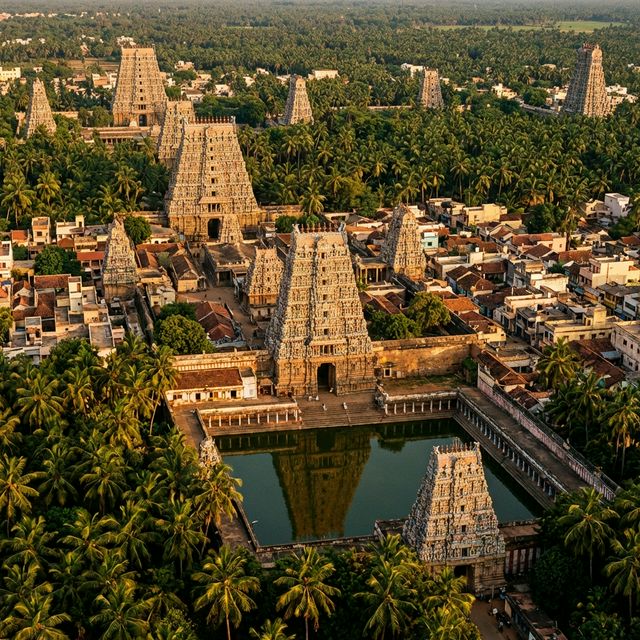

Everyone knows Hampi, Madurai, and Mysore. Every “South India heritage” list starts and ends with the same five places. And they’re all worth visiting — that’s not the argument.
- 1. Chettinad, Tamil Nadu
- 2. Belur and Halebidu, Karnataka
- 3. Thanjavur, Tamil Nadu
- 4. Kumbakonam, Tamil Nadu
- 5. Badami, Karnataka
- 6. Mamallapuram (Mahabalipuram), Tamil Nadu
- 7. Lepakshi, Andhra Pradesh
- 8. Tranquebar (Tharangambadi), Tamil Nadu
- 9. Srirangapatna, Karnataka
- 10. Gingee Fort, Tamil Nadu
- 11. Gangaikonda Cholapuram, Tamil Nadu
- 12. Thiruvannamalai, Tamil Nadu
- Which Ones to Combine
The argument is that South India has at least fifty heritage towns with architecture that would qualify for UNESCO consideration, living temple traditions, and a fraction of the crowds. Most Indian travelers haven’t heard of half of them. International tourists? Forget it.
Here are twelve that deserve a place on your itinerary. Not because they’re “offbeat” (I dislike that word — it implies they’re lesser), but because they’re genuinely extraordinary places that happen to lack an airport and a marketing budget.
1. Chettinad, Tamil Nadu
A cluster of 75 villages with palatial mansions built by the Chettiar merchant community in the 19th century. These aren’t palaces in the usual sense — they’re private homes, built by traders who made fortunes in Burma and Southeast Asia, then poured that wealth into importing Italian marble, Belgian mirrors, and teak from Burma to build homes in tiny Tamil Nadu villages.
Most mansions are now empty or crumbling. A few have been converted into heritage hotels. The Chettinad palace of the Raja of Chettinad alone has 106 rooms. The food here — Chettinad cuisine — is arguably South India’s most distinct regional flavour: aggressive spice, kari dosa, pepper chicken.
Best time: October-March. Getting there: Madurai airport, 80 km. Pro tip: Stay at Chidambara Vilas or Visalam for the authentic mansion experience. Walk-in visits to abandoned mansions are usually allowed if you ask the neighbours.
2. Belur and Halebidu, Karnataka
The Hoysala temples here make the argument for being the most detailed stone carvings in India. Not the biggest. Not the oldest. The most detailed. Every centimetre of the Chennakeshava Temple exterior is carved — gods, dancers, elephants, mythical creatures — and no two panels are identical.
They’re 16 km apart and usually done together in a half-day. Most visitors come from Hassan (30 km) and leave the same day. Which is a shame, because the evening light on Halebidu’s Hoysaleshwara Temple is extraordinary.
Best time: October-February. Getting there: Hassan is the base, 3.5 hrs from Bangalore by road. Pro tip: Hire a local guide at Belur (Rs 300-500). Without one, you’ll miss the context that makes the carvings remarkable — like the Darpana Sundari (lady with the mirror) whose bracelet casts a separate shadow.
3. Thanjavur, Tamil Nadu
The Brihadeeshwara Temple is a feat of engineering that shouldn’t exist. Built by Raja Raja Chola I in 1010 CE. The capstone on top of the 66-metre gopuram weighs 80 tonnes. How they got it up there in the 11th century is still debated. One theory involves a 6 km ramp.
But Thanjavur isn’t just the temple. The Maratha Palace complex has one of the best manuscript libraries in Asia. The Saraswathi Mahal Library contains texts on palm leaves from the medieval period. The art gallery in the palace has excellent Chola bronzes.
Best time: November-February. Getting there: Trichy airport (55 km), trains from Chennai. Pro tip: Visit the temple at dawn. By 9 AM, the tour buses arrive and the courtyard goes from meditative to chaotic.
4. Kumbakonam, Tamil Nadu
Known as the “temple city” — 188 temples within town limits. The density is absurd. You can walk between three 1,000-year-old temples in 20 minutes. The Airavatesvara Temple is a UNESCO World Heritage Site that receives a tenth of Thanjavur’s visitors.
Kumbakonam is also filter coffee headquarters. The town’s degree coffee is famous across Tamil Nadu, and sitting in a Kumbakonam coffee shop watching temple town life move at its own pace is one of those experiences that doesn’t photograph but stays with you.
Best time: October-March. Getting there: Thanjavur is 40 km away. Pro tip: Combine with Thanjavur and Gangaikonda Cholapuram for a Chola triangle road trip. Three days, three-temple circuit.
5. Badami, Karnataka
Cave temples carved into red sandstone cliffs overlooking an artificial lake. The Badami Chalukya dynasty did this in the 6th-7th century, and the scale is genuinely surprising when you turn the corner and see it for the first time.
Four main caves — Hindu and Jain — each with carved pillars and ceiling panels. Cave 3 has the largest and most detailed Vishnu panel I’ve seen outside Angkor Wat. That comparison sounds hyperbolic. Visit and decide for yourself.
Best time: October-March. Getting there: Hubli airport (100 km), Badami railway station. Pro tip: Combine with Aihole (34 km) and Pattadakal (22 km) — together they form the “Cradle of Indian Architecture.” Two days total.
6. Mamallapuram (Mahabalipuram), Tamil Nadu
Technically not unknown — it has UNESCO status. But most visitors see Arjuna’s Penance, the Shore Temple, and leave in three hours. That’s like visiting Hampi and only seeing Virupaksha.
The rock-cut rathas (temple chariots), the lighthouse hill, the Tiger Cave — these need a full day. And the seafood here is some of the best on the East Coast. Grilled fish at the beach shacks south of the Shore Temple, Rs 200-400 for a full meal.
Best time: November-February. Getting there: Chennai, 60 km. Pro tip: Go on a weekday. Weekend crowds from Chennai are intense. Stay overnight — sunrise at Shore Temple with nobody else there is worth the hotel cost.
7. Lepakshi, Andhra Pradesh
A single temple. But what a temple. The Veerabhadra Temple has a hanging pillar that doesn’t fully touch the ground — British engineers tried to move it and failed. The Nandi bull on the outskirts is carved from a single granite boulder and is reportedly the largest monolithic Nandi in India.
And the ceiling paintings. Vijayanagara-era murals covering the entire ceiling of the main hall — faded but intact. They’re being restored, slowly.
Best time: October-March. Getting there: Bangalore, 120 km (2.5 hrs by road). Pro tip: This is a day trip from Bangalore. Leave by 7 AM, back by 3 PM. Combine with Penukonda fort (50 km further) if you have energy.
8. Tranquebar (Tharangambadi), Tamil Nadu
A Danish colonial town on the Tamil Nadu coast. Yes, Danish. The Dansborg Fort was built in 1620 and is one of the only Danish colonial structures in Asia. The town has colonial-era churches, a lighthouse, and streets that look more Copenhagen than Coromandel.
It’s strange and beautiful and almost nobody visits. The Neemrana group runs a heritage hotel inside the fort — sleeping in a 400-year-old Danish colonial fort on the Bay of Bengal coast costs Rs 5,000-8,000/night and is worth every rupee.
Best time: November-February. Getting there: Karaikal (15 km), nearest major city is Pondicherry (120 km).
9. Srirangapatna, Karnataka
Tipu Sultan’s island fortress, 15 km from Mysore but visited by a fraction of Mysore Palace tourists. The fort is on an island in the Cauvery River. The Ranganathaswamy Temple here is one of the five holiest Vishnu temples for Sri Vaishnavas.
The Daria Daulat Bagh — Tipu’s summer palace — has the best-preserved 18th-century murals I’ve seen in South India. They depict the Battle of Pollilur where Tipu defeated the British. The detail is extraordinary.
Best time: October-March. Getting there: Mysore, 15 km. Pro tip: Combine with Mysore. Most people do this as a half-day trip, but the island deserves a full morning.
10. Gingee Fort, Tamil Nadu
Called the “Troy of the East” by the British. Three fortified hilltops connected by massive walls, spread across 11 sq km. The climb to Rajagiri (the highest hill) takes 90 minutes and rewards you with a view that stretches to the horizon in every direction.
This fort was fought over by the Vijayanagara empire, the Marathas, the Mughals, the French, and the British. Each one added to it. The archaeological layers are remarkable.
Best time: November-February (the climb is brutal in summer). Getting there: Pondicherry, 70 km. Villupuram station, 30 km. Pro tip: Start the climb before 7 AM. Carry 2 litres of water. There is no shade on the path.
11. Gangaikonda Cholapuram, Tamil Nadu
Rajendra Chola built this to rival his father Raja Raja Chola’s temple at Thanjavur. The Brihadeeshwara Temple here is architecturally equal to Thanjavur’s — same scale, same engineering — but receives maybe 5% of the visitors.
The Nandi here is considered superior to Thanjavur’s by art historians. The lion staircase is unique to this site. And the quiet — the sheer emptiness compared to Thanjavur — lets you appreciate the stonework without dodging selfie sticks.
Best time: October-March. Getting there: Kumbakonam, 35 km. Pro tip: Part of the Chola triangle. Do Thanjavur > Gangaikonda > Kumbakonam in 3 days.
12. Thiruvannamalai, Tamil Nadu
The Arunachaleswarar Temple is one of the largest temples in India — but that’s not why people come. They come for the Girivalam, the 14 km barefoot walk around the sacred Arunachala Hill. Hundreds of thousands do it on full moon nights.
Even if you skip the walk, the temple itself is worth 2-3 hours. The thousand-pillar hall. The gopurams. And the Ramana Maharshi Ashram at the base of the hill is one of the most peaceful places in Tamil Nadu.
Best time: November-February. Getting there: Chennai, 185 km (4 hrs). Bangalore, 200 km. Pro tip: Full moon Girivalam is the main event, but it’s also the most crowded. The day after full moon gives you the same walk with a fraction of the people.
Which Ones to Combine
| Circuit | Towns | Days |
|---|---|---|
| Chola Triangle | Thanjavur + Kumbakonam + Gangaikonda | 3 |
| Chalukya Circuit | Badami + Aihole + Pattadakal | 2 |
| Hoysala Day | Belur + Halebidu (from Hassan) | 1 |
| Bangalore Day Trips | Lepakshi or Srirangapatna (with Mysore) | 1 each |
| Tamil Coast | Mamallapuram + Tranquebar + Pondicherry | 4-5 |