








Quick Facts
- State: Karnataka
- Duration: 2-3 days minimum
- Budget: Rs 1,500-2,000/day (budget) | Rs 4,000-6,000/day (mid) | Rs 10,000+/day (premium)
- Best Season: October to March (avoid April-June, 40+ degrees C)
- Nearest Airport: Hubli (140 km) or Bangalore (350 km)
- Railway Station: Hospet Junction (13 km from Hampi)
- Best For: Solo, couples, photographers, history lovers
In 1565, a city larger than Rome — wealthier than most European capitals of the time — was sacked in six months. The temples were left standing. The palaces were left roofless. The market street still has its original stone foundations.
- The History You Actually Need
- What to See — The Six Essential Stops
- 1. Virupaksha Temple
- 2. Vittala Temple Complex
- 3. Royal Enclosure and Elephant Stables
- 4. Hemakuta Hill — Sunset
- 5. Matanga Hill — The One Thing
- 6. Hippie Island (Virupapur Gaddi)
- Suggested 2-Day Itinerary
- How to Reach
- Where to Stay
- Food
- What to Pack for Hampi
- Frequently Asked Questions
Everything you’re about to read is still there. In exactly that state. 460 years later.
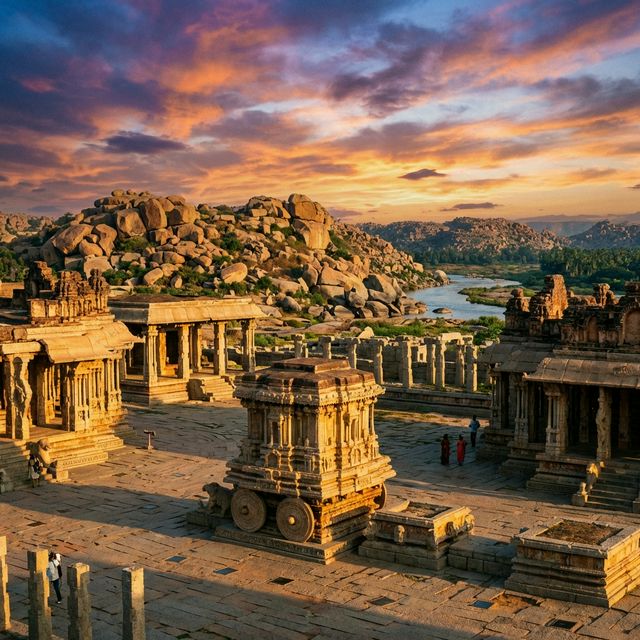
Hampi isn’t a single monument you visit and photograph and leave. It’s 26 square kilometres of ruined city spread across a boulder landscape that looks like a giant played marbles with granite. Over 1,600 structures. The Vijayanagara Empire built it over two centuries, and at its peak in the early 1500s, Portuguese traders wrote home describing streets paved with jewels. That part was exaggerated. The scale wasn’t.
The History You Actually Need
The Vijayanagara Empire was founded in 1336 by two brothers, Harihara and Bukka. The origin story involves a guru, a defeated army, and one of the most impressive reversals of fortune in Indian history — but the part that matters for your visit is this: they built an empire that controlled most of South India for over 200 years.
Hampi was the capital. And they made it extraordinary.
The empire’s wealth came from spice trade and control of key ports on the western coast. They used that wealth to build temples of absurd ambition — musical pillars, stone chariots, aqueduct systems that still puzzle engineers. They also employed Muslim architects for their secular buildings, which is why you’ll see Islamic domes on the Elephant Stables next to Hindu gopurams on the temples. This wasn’t confusion. It was cosmopolitan confidence.
In 1565, a coalition of five Deccan sultanates defeated Vijayanagara at the Battle of Talikota. What followed was six months of systematic destruction. The capital was abandoned. It was never reoccupied as a city. UNESCO made it a World Heritage Site in 1986.
What to See — The Six Essential Stops
1. Virupaksha Temple
Start here. Not because it’s the most famous — because it’s the most alive. This temple has been in continuous worship since the 7th century. While everything else in Hampi sits in ruins, Virupaksha has priests performing pujas, a kitchen serving free meals to pilgrims, and an elephant named Lakshmi who gets her morning bath in the river behind the temple around 8 AM.
The gopuram (tower) rises 50 metres. You can see it from across the river. Entry is free. Give it 45 minutes minimum.
2. Vittala Temple Complex
This is the one. The one on the Rs 50 note. The one that justifies the entire trip.
The stone chariot in the courtyard gets all the Instagram attention, but it’s not actually a chariot — it’s a shrine, shaped like a chariot, carved from granite. The wheels used to rotate. The engineering is absurd.
But what gets me — and I’ve studied this site for hours — is the musical pillars. 56 pillars in the main hall. Tap them and they produce distinct musical notes. British officers in the 1800s cut two of them open, trying to figure out if they were hollow. They weren’t. Solid stone. The sound comes from the mineral composition and the precise proportions of the carving.
Entry Rs 40. Allow 2 hours minimum. Open sunrise to sunset.
3. Royal Enclosure and Elephant Stables
The south side of Hampi. Where the kings lived. It feels completely different from the temple district — more Islamic influence, more secular grandeur.
The Elephant Stables: eleven domed chambers in a row. Each dome a different architectural design. Built for the royal elephants, and yes, they really did have eleven of them parked here.
The Lotus Mahal: two storeys of perfect symmetry. Possibly a recreation palace for the royal women. Look at the geometry of those windows. 400 years ago. No AutoCAD.
Combined entry with Vittala Temple (same Rs 40 ticket). 1.5 hours.
4. Hemakuta Hill — Sunset
Here’s the thing nobody on TripAdvisor emphasises enough.
Skip the afternoon sites on Day 1. Rest through the heat. Come to Hemakuta Hill at 5 PM.
This cluster of small temples between the bazaar and Krishna Temple is the best sunset point in Hampi. Maybe the best in Karnataka. The view over Virupaksha’s gopuram, with the boulder landscape behind it, turning gold and then pink — bring a tripod.
Free. 30-minute easy walk from the bazaar.
5. Matanga Hill — The One Thing
If you do nothing else in Hampi. Nothing.
Climb Matanga Hill for sunset on your second day.
It’s 40 minutes up. The path is boulders, not steps. Your legs will complain. There’s no railing. Don’t attempt it in monsoon or after dark.
But at the top, you see the entire ruined city below you. Every temple. Every boulder. Every remaining wall. All of it turning gold as the sun drops. And you understand — not intellectually, but in your chest — why they built a city here. And why losing it broke something that was never rebuilt.
Carry water. There’s no vendor at the top.
6. Hippie Island (Virupapur Gaddi)
Cross the river by coracle (round bamboo boat, Rs 50). The other side of Hampi — backpacker cafes, rice paddies, renting bicycles for Rs 150/day. Less ruins, more vibes. If you have a third day, spend the morning here cycling through the boulder landscape between temples nobody else visits.
Suggested 2-Day Itinerary
Day 1: Sacred Centre
Morning (7:00-12:00): Virupaksha Temple (catch Lakshmi’s bath at 8 AM) –> walk to Vittala Temple Complex (2 km, or auto Rs 50) –> explore the musical pillars and stone chariot
Afternoon (12:00-4:30): Lunch at Mango Tree restaurant (on the river, thali Rs 150-200) –> rest during the heat. Do not underestimate the Hampi sun.
Evening (5:00-6:30): Hemakuta Hill sunset. Carry a water bottle and a camera.
Day 2: Royal Enclosure + Matanga Sunset
Morning (7:00-11:00): Royal Enclosure –> Elephant Stables –> Lotus Mahal –> Queen’s Bath
Afternoon (12:00-4:30): Cross to Hippie Island for lunch and a bicycle ride. Laughing Buddha cafe does decent pasta and fresh juice — not authentic Karnataka food, but sometimes you need a break from thalis.
Evening (4:30-6:30): Matanga Hill sunset. Start climbing by 4:30 to be at the top by 5:15.
How to Reach
| From | Mode | Details | Cost |
|---|---|---|---|
| Bangalore | Train | Hampi Express overnight to Hospet (7-8 hrs) | Rs 350-600 |
| Bangalore | Bus | KSRTC Sleeper (7 hrs, departs 10 PM) | Rs 600-1,000 |
| Goa | Train | Vasco da Gama to Hospet (7 hrs) | Rs 300-500 |
| Hyderabad | Train | Kacheguda to Hospet (10 hrs overnight) | Rs 400-700 |
| Hospet to Hampi | Auto | 13 km, 20 minutes | Rs 150-250 |
Where to Stay
Two sides, completely different character.
Hampi Bazaar side (recommended for first-timers): walking distance to Virupaksha Temple, restaurants, ruins. Convenient but basic.
Hippie Island / Virupapur Gaddi (for return visitors): across the river by coracle, paddy fields, backpacker cafes. More peaceful but you need a boat to get to ruins. Coracle service stops at dark.
| Tier | Option | Side | Price |
|---|---|---|---|
| Budget | Goan Corner / Shanti Guesthouse | Hippie Island | Rs 600-1,000/night |
| Budget | Padma Guest House | Bazaar | Rs 800-1,200/night |
| Mid | Heritage Resort Hampi | 3 km from Hampi | Rs 2,500-4,000/night |
| Premium | Evolve Back (formerly Orange County) | Outside Hampi | Rs 12,000+/night |
Food
Hampi has surprisingly decent food for a village with 500 permanent residents.
- Mango Tree (river-side, Bazaar area): The most famous. Sit on floor mats under mango trees by the Tungabhadra. Thali Rs 150-200. Go for lunch, not dinner — the view is the point.
- Laughing Buddha (Hippie Island): International menu. Falafel, pasta, smoothies. Budget traveler’s lifeline. Rs 150-300.
- Chill Out (Hippie Island): Breakfast spot. Banana pancakes and filter coffee. Rs 100-150.
Skip the museum restaurant. Trust me on this one.
What to Pack for Hampi
| Item | Why (Hampi-specific) |
|---|---|
| Closed-toe walking shoes | Boulder terrain. Sandals won’t work for Matanga Hill or the Royal Enclosure paths. |
| 2-litre water bottle | No vendors between major sites. The distances are real. |
| Sunscreen + wide hat | No shade between ruins. October-March sun is still strong. |
| Torch/flashlight | Some temple interiors and Matanga descent in fading light. |
| Light scarf | Doubles as sun cover and temple dress code compliance. |
Frequently Asked Questions
How many days for Hampi?
Two days covers the essentials. Three days is ideal — lets you cycle Hippie Island and explore ruins nobody else visits. One day is technically possible but genuinely rushed.
Is Hampi safe for solo women?
Yes. It’s a major tourist and pilgrimage site. Bazaar area is populated. Hippie Island is backpacker-friendly. Avoid walking between sites alone after dark — more for terrain safety than anything else.
Best time to visit?
October to March. April-June temperatures hit 40+ degrees C and exploring ruins in that heat isn’t enjoyable, it’s medical. Monsoon (July-Sept) makes boulder paths slippery and the coracle to Hippie Island stops running.
Hampi vs Badami — which should I visit?
Both, if you have time — they’re 140 km apart. But if forced to choose: Hampi for scale and landscape, Badami for cave temples and quieter exploration.
Can I rent a bicycle?
Yes, Rs 100-150/day from shops on both sides. Best way to explore. But the terrain is uneven so gear-cycle is recommend over single-speed.
Is the Rs 40 entry a single ticket?
Yes — one ticket covers Vittala Temple, Royal Enclosure, and Lotus Mahal. Buy at Vittala Temple and keep it. Valid full day.