








Quick Facts
- Duration: 3 days / 2 nights
- Budget: Rs 5,000-8,000 (budget) | Rs 12,000-20,000 (mid) | Rs 25,000-40,000 (premium)
- Best Season: October to March (avoid May-June, 45+ degrees C)
- Nearest Airport: Lal Bahadur Shastri Airport (26 km from ghats)
- Railway Station: Varanasi Junction (Cantt) or Varanasi City
- Best For: Solo, photographers, spiritual seekers, history lovers
Can you “do” Varanasi in two days? Yes. Every budget travel blog says so. They’re wrong.
- Day 1 — The River and the Ghats
- Morning: Sunrise Boat Ride (5:00-7:00 AM)
- Morning: Ghat Walk (7:30-11:00 AM)
- Afternoon: Rest and Old City (2:00-5:00 PM)
- Evening: Ganga Aarti at Dashashwamedh (6:30-7:30 PM)
- Day 2 — Temples, Silk, and the University
- Morning: Kashi Vishwanath Temple (6:00-8:00 AM)
- Morning: Sarnath (9:00 AM-12:00 PM)
- Afternoon: Silk Weaving District (2:00-4:00 PM)
- Evening: BHU Campus Walk (4:30-6:30 PM)
- Day 3 — Dawn Walk and Departure
- Where to Stay
- Frequently Asked Questions
Two days gives you the sunrise boat ride, the evening Ganga Aarti, and a walk through some lanes. That’s the postcard experience. But Varanasi isn’t a postcard — it’s a city that has been continuously inhabited for over 3,000 years, with 84 ghats, a silk-weaving tradition, a university older than most Indian states, and a relationship with death that will rewire how you think about mortality.
Three days is the minimum to move past “tourist experience” into actual understanding. This itinerary builds from gentle to intense, morning to evening, so you accumulate context before hitting the parts that need it.
Day 1 — The River and the Ghats
Morning: Sunrise Boat Ride (5:00-7:00 AM)
This is non-negotiable. Book a boat the evening before from Dashashwamedh Ghat. Rs 200-300 for a shared boat, Rs 800-1,200 for a private one (fits 4-6 people). Start at 5:15 AM. The boatman rows upstream past Manikarnika.
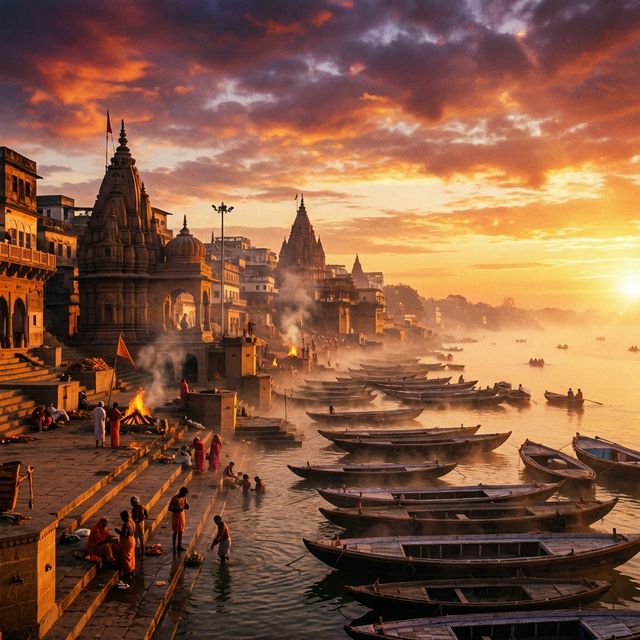
Here’s the thing about morning on the Ganges — it’s not “peaceful” in the Instagram sense. It’s layered. Cremation smoke from Manikarnika drifts over the water. Pilgrims perform rituals at the steps. Yoga practitioners stretch on the higher ghats. Laundry gets beaten against stone. All of this is happening simultaneously, at 5:30 in the morning, and has been happening in exactly this way for centuries.
As the sun clears the eastern bank, the sandstone of the ghats turns gold. For about 12 minutes. That’s your photography window.
Morning: Ghat Walk (7:30-11:00 AM)
After the boat, walk the ghats on foot. Start at Assi Ghat (the southern end — quieter, students, cafes) and walk north. You’ll cover maybe 15-20 ghats in 3 hours, depending on how often you stop.
Key stops on the walk:
- Tulsi Ghat — where the poet Tulsidas wrote parts of the Ramcharitmanas.
- Harishchandra Ghat — the smaller of the two cremation ghats. Less intense than Manikarnika for first exposure.
- Kedar Ghat — the most photogenic. Tiered steps, morning bathers, temple spires above.
- Dashashwamedh Ghat — the main one. Boat moorings, wrestlers exercising, chai sellers.
Afternoon: Rest and Old City (2:00-5:00 PM)
Varanasi afternoons in tourist season are 28-32 degrees C. Rest at your hotel until 2. Then walk the old city lanes — the narrow alleys behind the ghats where silk weavers work, sweet shops stack jalebis, and you will get lost. Getting lost is not the risk. It’s the method.
Visit Blue Lassi Shop (near Manikarnika). There’s no sign worth mentioning. Ask anyone. The mango lassi here is thick enough to hold a spoon vertical. Rs 40-60.
Evening: Ganga Aarti at Dashashwamedh (6:30-7:30 PM)
Arrive by 5:45 PM for a decent spot. The aarti starts at sunset. Seven priests perform choreographed fire rituals with massive brass lamps, bells, conch shells. It’s 45 minutes of orchestrated devotion, and whether you’re religious or not, the crowd energy is remarkable.
Two ways to watch: From the ghat steps (free, crowded) or from a boat on the river (Rs 100-200/person, better view, less crushing).
Dinner: Kashi Chaat Bhandar near Dashashwamedh. Tamatar chaat (tomato chaat) is their signature. Rs 30-50 per plate. Follow it with the thandai from any ghat-side stall — a spiced milk drink that’s essentially Varanasi in a glass.
Day 2 — Temples, Silk, and the University
Morning: Kashi Vishwanath Temple (6:00-8:00 AM)
One of the twelve Jyotirlingas. The most sacred Shiva temple in India. The new Kashi Vishwanath Corridor has transformed access — it’s cleaner, more organized, and honestly more impressive than before the renovation.
Security is airport-level. No phones, no bags, no cameras. Leave everything at the locker facility (free, well-organized). Expect 30-45 minutes in line on a normal day. Go at 6 AM and it drops to 10-15 minutes.
Morning: Sarnath (9:00 AM-12:00 PM)
10 km from the ghats. Auto Rs 200-300. This is where Buddha delivered his first sermon after enlightenment. The Dhamek Stupa is 43 metres tall and 1,600 years old. The Archaeological Museum here has the original Lion Capital of Ashoka — the emblem that’s on every Indian coin and government document.
Skip it on your “Varanasi spiritual” trip and you’ve missed arguably the most historically significant Buddhist site in India. Don’t do that.
Entry: Rs 25 (museum separate, Rs 5). Allow 2 hours.
Afternoon: Silk Weaving District (2:00-4:00 PM)
Varanasi produces some of India’s finest silk. The weaving workshops are in the Muslim quarter — narrow lanes off the main ghat roads. Ask your hotel to connect you with a weaver’s workshop (not a showroom — an actual workshop). Watch the process: jacquard looms, sometimes manual, producing brocade that takes 15-45 days per saree.
Buying silk? A genuine Banarasi silk saree starts at Rs 3,000-5,000 for simple designs and goes up to Rs 50,000+ for heavy brocade. If someone’s selling “pure silk” for Rs 800, it’s not silk. That’s not snobbery — it’s mathematics. The raw material alone costs more.
Evening: BHU Campus Walk (4:30-6:30 PM)
Banaras Hindu University is one of the largest residential universities in Asia. The campus is a green, quiet counterpoint to the old city chaos. The New Vishwanath Temple inside BHU is modelled on the original Kashi Vishwanath — and it’s gorgeous. Open to all, no queue, beautifully maintained.
The Bharat Kala Bhavan museum on campus has miniature Mughal paintings and archaeological treasures. It’s small and underrated. Entry Rs 20.
Day 3 — Dawn Walk and Departure
Morning: Manikarnika Ghat (5:30-7:00 AM)
By Day 3, you have enough context for this. Manikarnika is the primary cremation ghat — fires have been burning here continuously for, depending on which tradition you follow, somewhere between 3,000 and 5,000 years. 24 hours a day. 365 days a year. The fire has never gone out.
Stand quietly. Watch. There’s no narration required. The geometry of it — wood being weighed, bodies being carried down the steps, fire being transferred from the eternal flame, families standing at the water’s edge — says everything about how Varanasi relates to death. Which is: not as an ending.
Morning: Subah-e-Banaras (7:00-9:00 AM)
A morning of street food and chai. Walk from Manikarnika south to Assi. Stop at every stall that catches your eye. Kachori-sabzi for breakfast. Clay-cup chai. The morning energy on the ghats after the tourist boats leave is entirely different — local, domestic, rhythmic.
Departure: Vande Bharat from Varanasi to Delhi (8 hrs, Rs 1,600-2,400). Or flights from Babatpur Airport (1.5 hrs to Delhi, Rs 3,000-5,000).
Where to Stay
Stay near Assi Ghat for quieter mornings, backpacker cafes, and easy ghat access. Or near Dashashwamedh for central access but more noise and hawkers.
| Tier | Hotel | Area | Price |
|---|---|---|---|
| Budget | Zostel Varanasi | Assi Ghat | Rs 600-900/bed |
| Budget | Ganpati Guesthouse | Meer Ghat | Rs 1,000-1,500/night |
| Mid | Hotel Alka | Dashashwamedh | Rs 2,500-4,000/night |
| Premium | BrijRama Palace | Darbhanga Ghat | Rs 8,000-15,000/night |
| Premium | Suryauday Haveli | Shivala Ghat | Rs 6,000-10,000/night |
Frequently Asked Questions
Is Varanasi safe for solo women?
The ghats are safe during daytime and evening aarti. Old city lanes after dark can be dimly lit. Stick to main paths. The tourist infrastructure is well-established.
Vegetarian food only?
The old city is almost entirely vegetarian. Non-veg restaurants exist in Cantonment area and near BHU. Don’t expect to find meat near the ghats.
Can I photograph at the ghats?
Yes, respectfully. Not at cremation ghats. Not close-ups of bathers without permission. Long lens from a boat is the standard approach and generally accepted.
How to handle touts?
Firmly and politely. “No thank you” once is enough. Don’t engage in conversation if you’re not interested. It stops after Day 1 — they recognize returning visitors.